

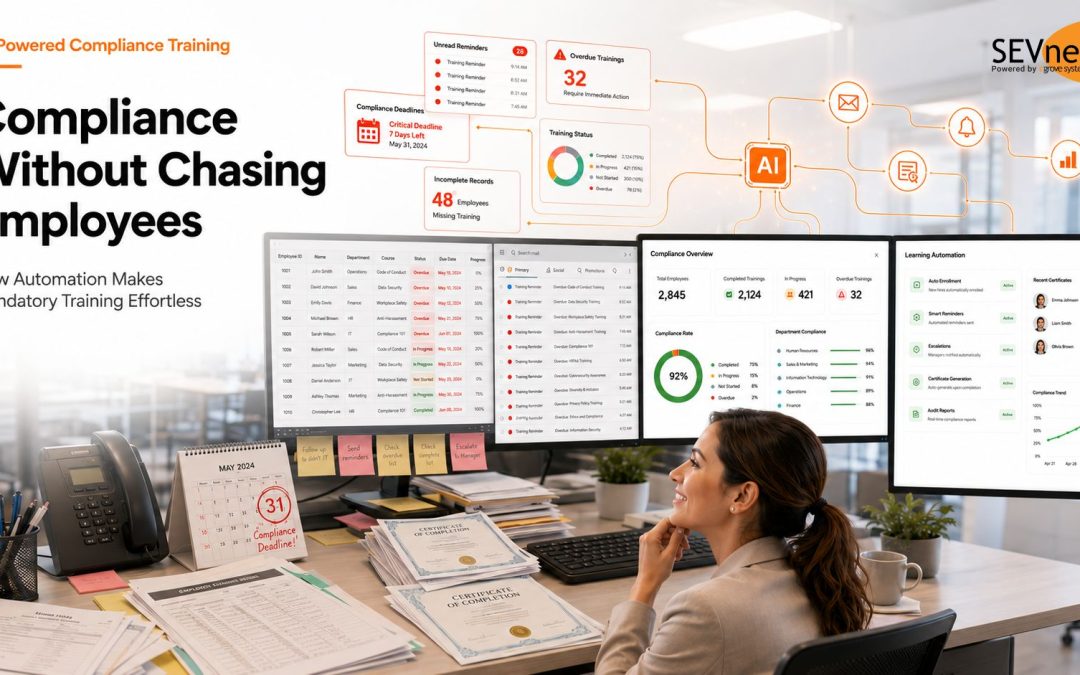
Imagine it’s Friday afternoon.
Your compliance deadline is just three days away, and your inbox is full.
Twenty-seven employees still haven’t finished their mandatory training. Managers are asking who is behind. The compliance team is updating Excel spreadsheets. HR is sending reminder emails for the third time this week.
Meanwhile, the business continues as usual.
This situation is familiar to many HR managers, compliance officers, and learning and development teams.
Managing mandatory employee training by hand becomes harder as organizations grow. What starts as a simple process for 50 employees can quickly become overwhelming when you’re responsible for hundreds or even thousands of learners across different departments and locations.
The hidden costs go beyond HR workload.
Manual compliance management often leads to:
- Lost productivity from repetitive administrative tasks
- Employees missing mandatory deadlines
- Increased compliance risks
- Stress during audits
- Incomplete documentation
- Poor visibility into training status
- Employee frustration from inconsistent communication
Fortunately, organizations no longer need to depend on spreadsheets, email chains, and manual follow-ups.
Compliance training automation helps businesses streamline mandatory learning, reduce administrative effort, improve completion rates, and maintain audit-ready records, all while giving HR more time to focus on strategic initiatives.
We’ll explore how automation transforms corporate compliance training, why manual processes often fail, and how an AI-powered learning platform can simplify compliance management across your organization.
Why Manual Compliance Management Fails
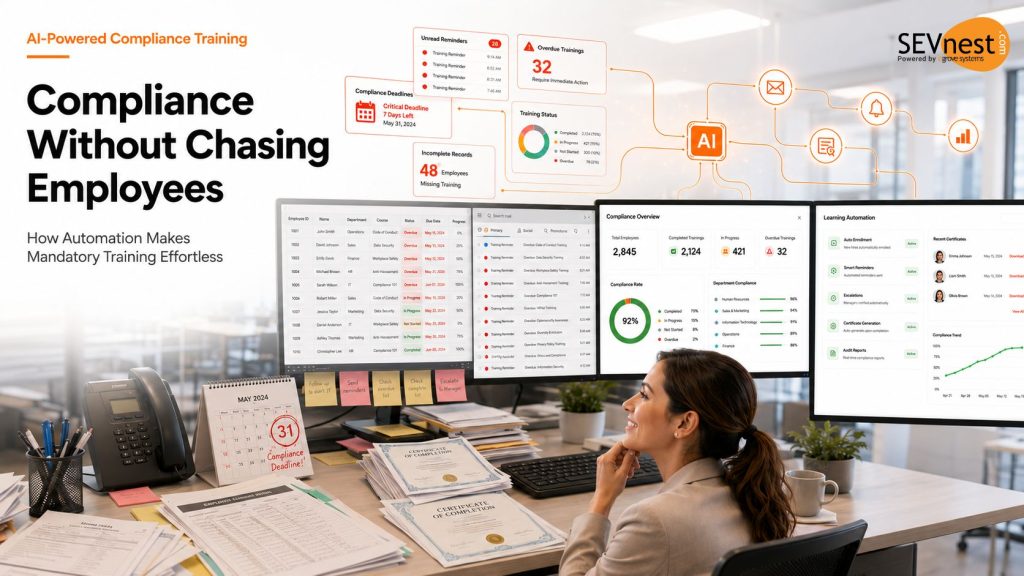
- Most organizations don’t struggle because they lack training programs.
- They struggle because they rely on manual processes to manage them.
- As organizations expand, manual compliance tracking introduces delays, inconsistencies, and unnecessary administrative work.
Email Reminders Get Ignored
- Employees receive dozens of emails each day.
- Training reminders compete with meeting invitations, project updates, customer messages, and internal announcements.
- Eventually, reminder emails get overlooked.
- HR responds by sending more reminders, creating even more administrative work.
Spreadsheets Become Outdated
This approach creates several challenges:
- Files become outdated quickly
- Multiple versions create confusion
- Human errors are common
- Status updates require manual entry
- Reporting becomes time-consuming
- Without real-time updates, HR rarely has a complete picture of workforce compliance
Managers Lack Visibility
Department managers often don’t know:
- Which employees are overdue
- Which certifications have expired
- Which onboarding courses remain incomplete
Instead, they depend on HR to provide manual reports.
This slows decision-making and creates unnecessary communication loops.
Missed Compliance Deadlines
- Manual tracking increases the likelihood of missed deadlines.
- Employees may forget upcoming due dates.
- Managers may overlook overdue training.
- HR may discover gaps only during audit preparation.
- By then, corrective action becomes much more difficult.
Human Error Becomes Inevitable
No matter how experienced the HR team is, manual processes leave room for mistakes.
Examples include:
- Missing employee assignments
- Incorrect completion records
- Forgotten certificate renewals
- Duplicate reminders
- Inaccurate reporting
Automation significantly reduces these risks
What Is Compliance Training Automation?
Compliance training automation uses software to manage the entire compliance learning process with minimal manual intervention.
Instead of HR coordinating every training activity, the platform automatically handles routine tasks based on predefined rules.
A modern AI-powered LMS can automatically:
- Enroll employees into required courses
- Assign role-based learning paths
- Send reminder notifications
- Escalate overdue training to managers
- Track learner progress
- Generate certificates
- Produce audit-ready reports
- Monitor compliance status across departments
Automation doesn’t replace HR.
It empowers HR teams to focus on employee development instead of repetitive administrative work.
How Compliance Training Automation Works
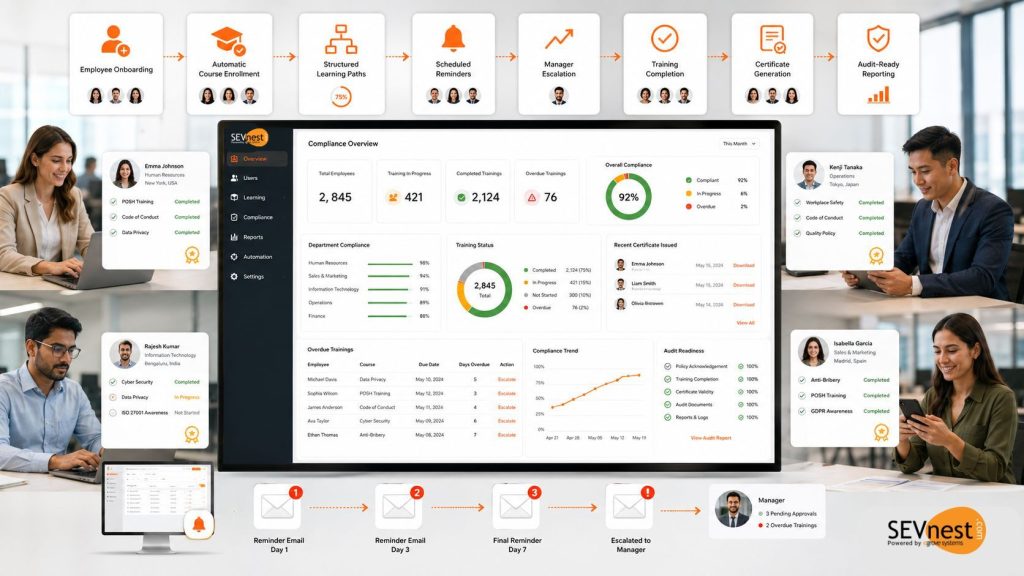
A modern compliance management software typically follows this workflow:
1.Automatic Enrollment
Employees are automatically enrolled based on:
- Department
- Job role
- Location
- Business unit
- Compliance requirements
New hires can begin employee onboarding training immediately without HR assigning courses manually.
2. Learning Paths
Instead of assigning courses individually, HR creates structured learning journeys.
For example:
- New Sales Employee:
- Code of Conduct
- Data Privacy
- Cybersecurity Awareness
- Anti-Harassment Training
- Workplace Safety
Every employee receives the right training automatically.
3. Automated Employee Reminders
- The system sends notifications before deadlines.
- If training remains incomplete, reminder frequency can increase automatically.
- No manual follow-up is required.
4. Escalation Rules
If employees continue missing deadlines, the system can notify:
- Reporting managers
- Department heads
- Compliance officers
This improves accountability without increasing HR workload.
5. Training Completion Tracking
Every learner’s progress updates in real time.
HR can instantly see:
- Not Started
- In Progress
- Completed
- Overdue
6. Certificate Generation
Upon successful completion, certificates are issued automatically and securely stored for future reference.
7. Compliance Reporting
Dashboards provide real-time reports showing:
- Completion percentages
- Department performance
- Overdue learners
- Certification status
- Upcoming renewals
These reports help organizations stay audit-ready throughout the year.
Benefits of Automated Compliance Training
Automation delivers measurable operational improvements across HR, compliance, and business leadership.
1. Higher Training Completion Rates
Employees receive consistent reminders until training is completed.
Managers gain visibility into overdue learners, improving accountability.
2. Reduced HR Workload
Routine administrative tasks disappear.
HR spends less time:
- Sending emails
- Updating spreadsheets
- Preparing reports
- Following up with employees
3. Better Employee Accountability
Employees know exactly:
- What training is assigned
- When it is due
- What remains incomplete
Clear expectations encourage timely completion.
4. Audit Readiness
Every activity is automatically documented.
Organizations can quickly retrieve:
- Completion records
- Certificates
- Assessment scores
- Training history
This simplifies compliance reporting during audits.
5. Real-Time Visibility
Instead of waiting for monthly reports, leadership can monitor workforce compliance through live dashboards.
6. Reduced Compliance Risks
Automation helps ensure required training is assigned, completed, tracked, and documented before deadlines.
7. Significant Time Savings
HR teams reclaim hours previously spent on repetitive administrative work.
Those hours can be invested in employee engagement, talent development, and strategic workforce planning.
8. Improved Reporting
Automated reports eliminate manual data compilation.
Leaders receive accurate, consistent compliance insights whenever needed.
9. Consistent Employee Onboarding
Every new employee follows the same compliance learning journey.
Nothing gets overlooked.
10. Scalability
Whether your organization has:
- 100 employees
- 1,000 employees
- 10,000 employees
Automation scales without dramatically increasing HR effort.
Features Every Modern Compliance LMS Should Have
Selecting the right learning management system is essential for long-term compliance success.
Look for these capabilities:
AI-Powered Automation
Automatically assign courses based on employee profiles, roles, or departments while reducing manual administration.
Structured Learning Paths
Deliver mandatory training in logical sequences for onboarding, annual compliance, or role-specific requirements.
Multi-Location Support
Manage compliance consistently across offices, branches, remote teams, and international operations.
Department-Wise Assignments
Assign courses based on:
- Department
- Role
- Region
- Business unit
Role-Based Training
Ensure employees receive only training relevant to their responsibilities.
Mobile Learning
Employees should be able to complete training securely from desktops, tablets, or smartphones.
Analytics Dashboard
Provide real-time insights into:
- Completion rates
- Engagement
- Compliance status
- Learning progress
Automated Employee Reminders
Reduce missed deadlines through scheduled notifications and escalation workflows.
Certification Management
Automatically issue, store, and renew compliance certificates.
Assessment Engine
Measure employee understanding through quizzes, assessments, and knowledge checks.
Compliance Reporting
Generate audit-ready reports with minimal effort.
HR System Integrations
Integrate with HRMS, identity management, and enterprise systems to reduce duplicate data entry and improve operational efficiency.
Why AI Improves Compliance Management
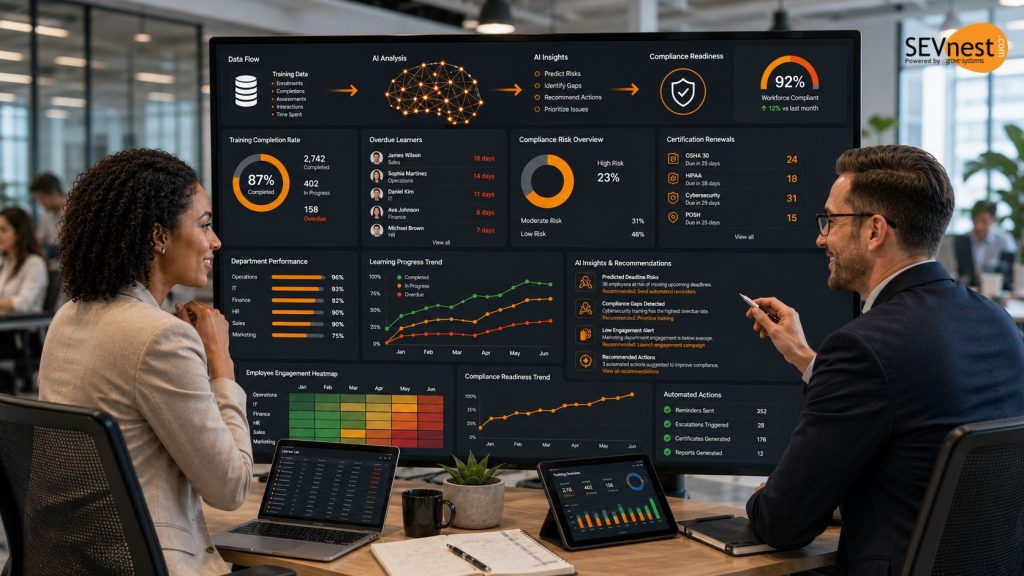
Artificial intelligence is transforming how organizations deliver and manage compliance learning.
Instead of simply digitizing training, AI helps organizations become more proactive and efficient.
Personalized Learning
AI can recommend relevant courses based on:
- Employee role
- Department
- Previous learning history
- Compliance requirements
This creates a more meaningful learning experience.
Predicting Delays
AI can identify employees who are at risk of missing deadlines based on engagement patterns, enabling earlier intervention.
Detecting Compliance Gaps
By analyzing completion data across teams, AI highlights areas where additional training or policy reinforcement may be needed.
Smarter Reporting
AI-powered reporting surfaces trends, highlights overdue areas, and presents insights in a format that helps HR make informed decisions more quickly.
Reduced Administrative Work
AI automates repetitive processes like course assignments, reminders, reporting, and certification tracking, allowing HR teams to focus on strategic initiatives.
Common Compliance Training Mistakes
Many organizations unintentionally create compliance risks through outdated practices.
Common mistakes include:
- Tracking training manually in spreadsheets
- Sending only one reminder email
- Using outdated LMS platforms
- Providing generic training for every employee
- Lacking centralized compliance reporting
- Waiting until audit season to review records
- Not tracking certification renewals
- Failing to monitor progress in real time
Addressing these issues can significantly improve compliance performance and reduce administrative effort.
How SEVnest Helps Simplify Compliance Training
Modern organizations need more than a basic learning platform. They need an intelligent solution that simplifies compliance management while supporting workforce development.
SEVnest is an AI-powered LMS designed to help organizations automate employee compliance training at scale.
With SEVnest, organizations can:
- Automate learning paths based on roles and departments
- Deliver mandatory employee training consistently
- Track compliance completion in real time
- Send automated employee reminders
- Generate certificates automatically
- Monitor workforce compliance through centralized dashboards
- Produce audit-ready compliance reports
- Support employee onboarding training from day one
- Manage training across multiple locations
- Scale enterprise learning without increasing administrative overhead
Rather than spending valuable time chasing employees, HR teams gain the visibility and automation needed to manage compliance efficiently and confidently.
Final Thoughts
Compliance shouldn’t depend on endless reminder emails, outdated spreadsheets, or last-minute audit preparation.
As organizations grow, manual processes become increasingly difficult to sustain.
Compliance training automation enables HR and compliance teams to reduce administrative effort, improve training completion, maintain accurate records, and stay prepared for audits throughout the year.
By combining automation, AI, centralized reporting, and scalable learning management, organizations can build a stronger compliance culture while freeing HR to focus on people instead of paperwork.
If your organization is ready to modernize corporate compliance training, explore how SEVnest can help simplify compliance management, improve workforce accountability, and create a more efficient learning experience.